📚 Merchant Academy · Reading
The History of Bookkeeping
Why Should We Learn Accounting?
From Italian merchants to modern companies, discover why understanding money matters.
Introduction: A Ledger Is a Map of Money
Imagine opening a pepper shop. How many gold coins did you receive today? How many bags of pepper are left? How much profit did you really make?
A ledger records where money and goods come from and where they go. In double-entry bookkeeping, each transaction has a debit (left) and a credit (right), recorded for equal amounts.
📖 Record it in the merchant's journal
Left 60 = Right 60 ✓
The shop exchanges 60 gold coins for pepper worth 60 coins. Both sides of the journal record the same amount.
Learning bookkeeping does not guarantee that you will become rich. It helps you understand assets, debts and profits so you can make better decisions.
Chapter 1 · Italy
How Merchants Developed Double-Entry Bookkeeping
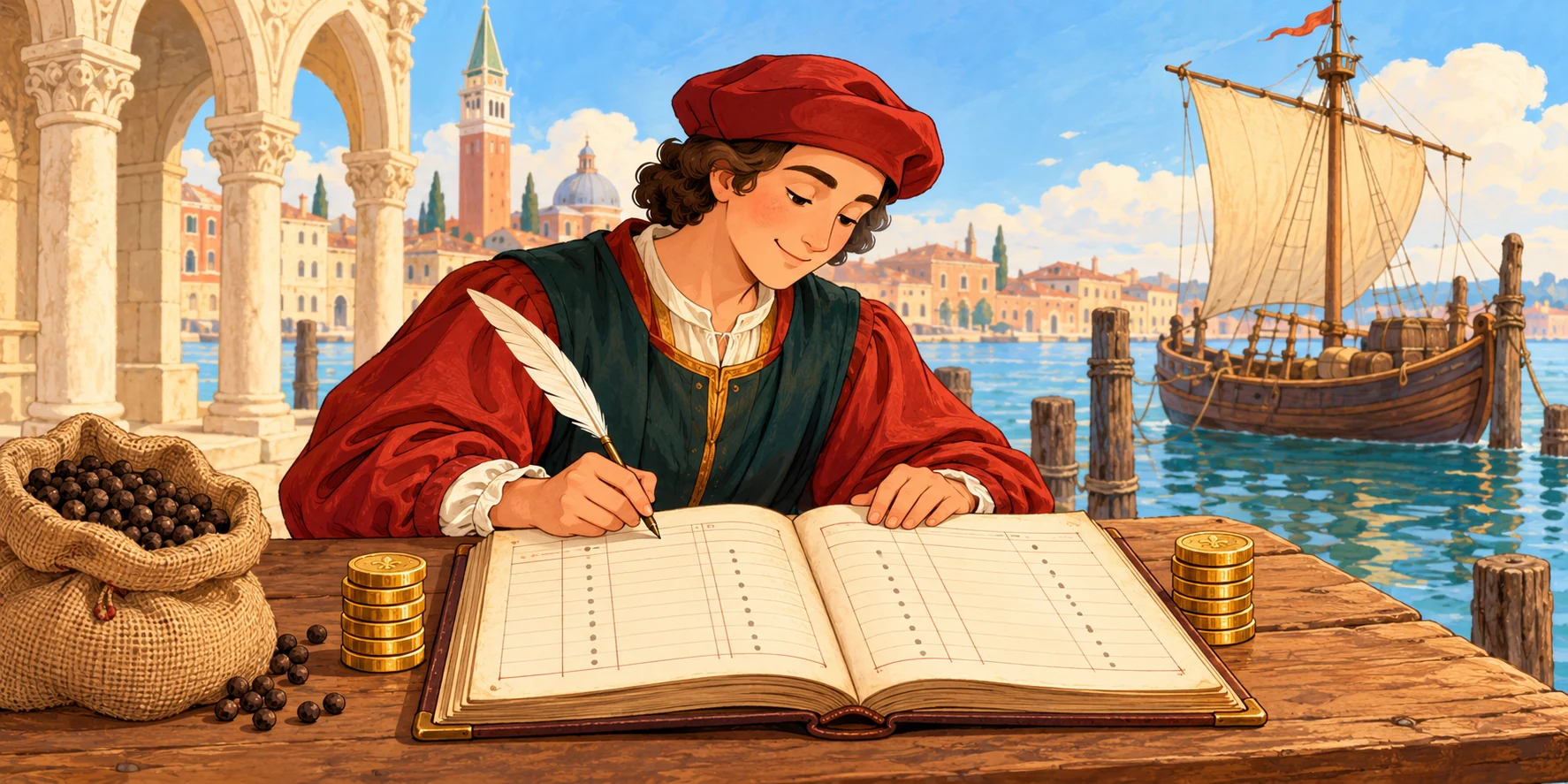
In northern Italy around AD 1300, merchants transported goods between distant cities and invested money together. They needed to know who had contributed money, who was owed money and how much profit a journey made.
Double-entry bookkeeping grew in this commercial world. In AD 1494, mathematician Luca Pacioli described bookkeeping methods in a printed book. The system had developed before the great ocean voyages of the Age of Discovery.
In the late 1300s and early 1400s, the merchant Francesco Datini left records showing how trade, faith and ideas about responsibility were connected in his time.
Chapter 2 · Florence
Why Did the Medici Bank Decline?

In the first half of the 1400s, Cosimo de' Medici led the Medici Bank. During his leadership, from about 1429 to 1464, the bank expanded its business across Europe. Accounts and reports helped its leaders understand what distant branches were doing.
Later, the bank faced risky loans, difficulties managing its branches and other problems. It declined after Cosimo's death in 1464 and came to an end in 1494. Its story reminds us that good records are useful only when people study them and act on warning signs.
Chapter 3 · European Trading Powers
Spain and the Netherlands: Is Having Money Enough?
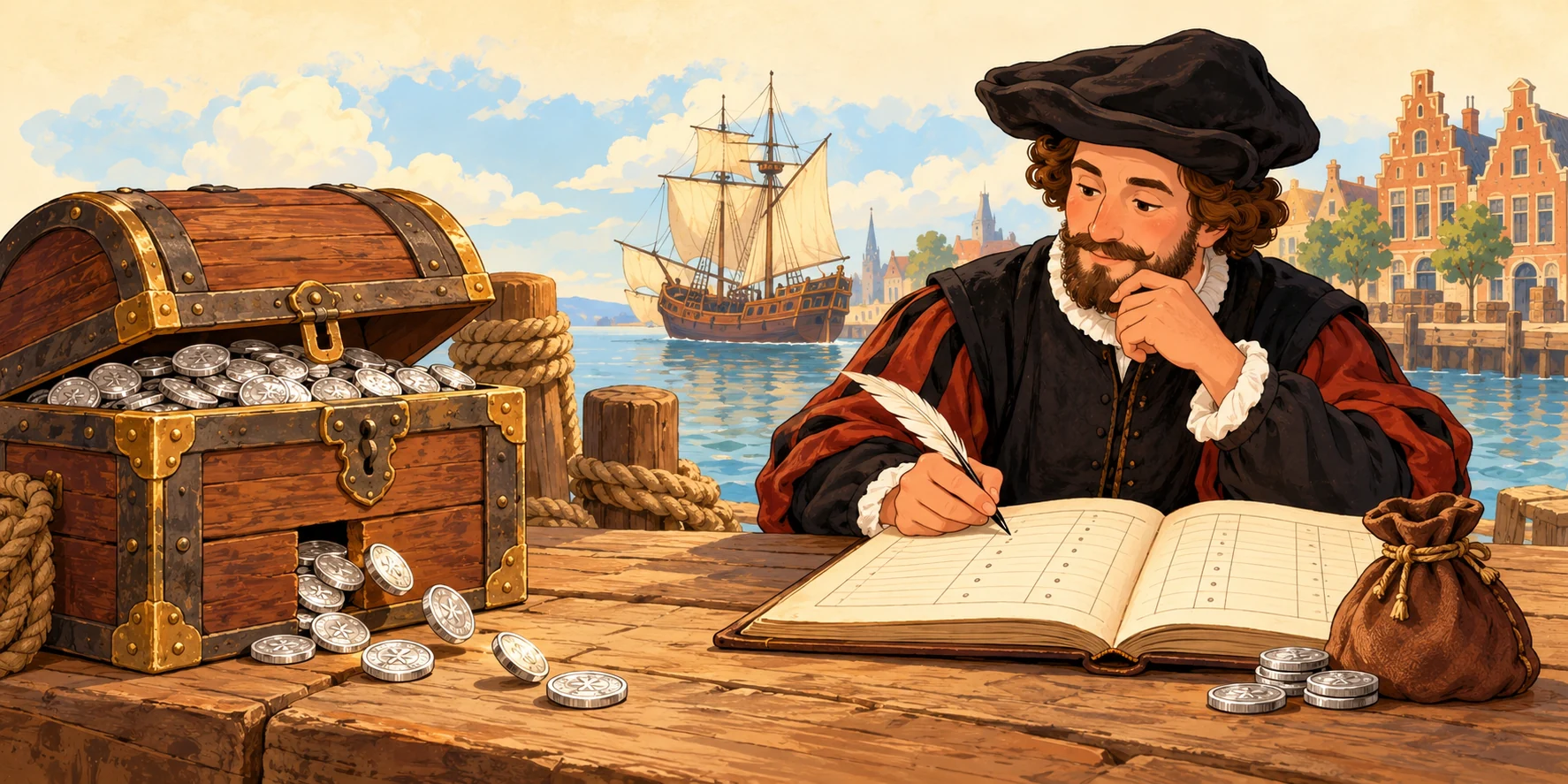
During the 1500s, Spain obtained large amounts of silver from the Americas, especially from the Potosí mines in present-day Bolivia and the Zacatecas mines in present-day Mexico. But wars against rebels in the Low Countries (around today's Netherlands and Belgium) from about 1568, and against England from 1585, cost enormous sums and added to the kingdom's debts. Under Philip II, the Crown suspended debt payments in 1557, 1575 and 1596. A debt payment suspension means that a government temporarily stops making some promised repayments and negotiates new terms with its lenders. It does not mean all its debts disappear. The 1557 crisis also reflected debts inherited from the previous king. Receiving a lot of silver did not mean Spain could afford all its spending.
First, merchants and banks that lent money to the government may not receive their money on the promised date. This can cause financial trouble for the lenders themselves.
Other lenders may worry that they will not be repaid. The government may then find it harder to borrow again, or may have to pay higher interest.
If the government raises taxes or cuts spending to find money, ordinary people's lives may also be affected.
So a government's debt problems can affect merchants, banks and families—not just the ruler.
But higher taxes and hardship are not inevitable. In Spain's case, the Crown mainly renegotiated repayment terms with lenders; the whole economy did not simply stop.
During the late 1500s and 1600s, merchants and towns in the Netherlands developed systems for recording transactions using double-entry bookkeeping and managing funds. These helped support trade and finance. Bookkeeping alone cannot explain why a country prospers, but careful records matter.
Chapter 4 · France
A King's Ledger and the Cost of Government

In the 1600s, under Louis XIV (who reigned from 1643 to 1715), finance minister Jean-Baptiste Colbert worked to understand and improve royal finances. Palaces and wars were expensive. Even a king could spend more than he received.
By the late 1700s, France had borrowed heavily to pay for wars. While many ordinary families struggled under heavy taxes, nobles at court enjoyed lavish lives and exemptions from many taxes.
Jacques Necker, a former banker in charge of King Louis XVI's finances, faced criticism from powerful people at court. In 1781, he made a bold move: he published information about royal finances that had previously been treated as highly confidential within the royal administration and kept from the general public.
The report included spending by the royal household and pensions paid to privileged people. Necker wanted to defend his record and persuade lenders that France could manage its money and repay its debts.
Four years later, in 1785, an extraordinary scandal shocked France: the Affair of the Diamond Necklace.
The necklace contained nearly 650 diamonds and cost an astonishing 1.6 million livres. Fraudsters used Queen Marie Antoinette's name in a scheme to obtain it. The queen herself had refused to buy the necklace.
Yet rumours spread that the queen had wanted such an extravagant jewel. At a time when many people were angry about taxes and hardship, the scandal further damaged trust in the royal court.
Financial troubles and political conflict continued. In 1789, the French Revolution began. Records of public money helped people ask an important question: where was the nation's money going?
Chapter 5 · The Modern World
Why Can Big Failures Happen Even with Ledgers?
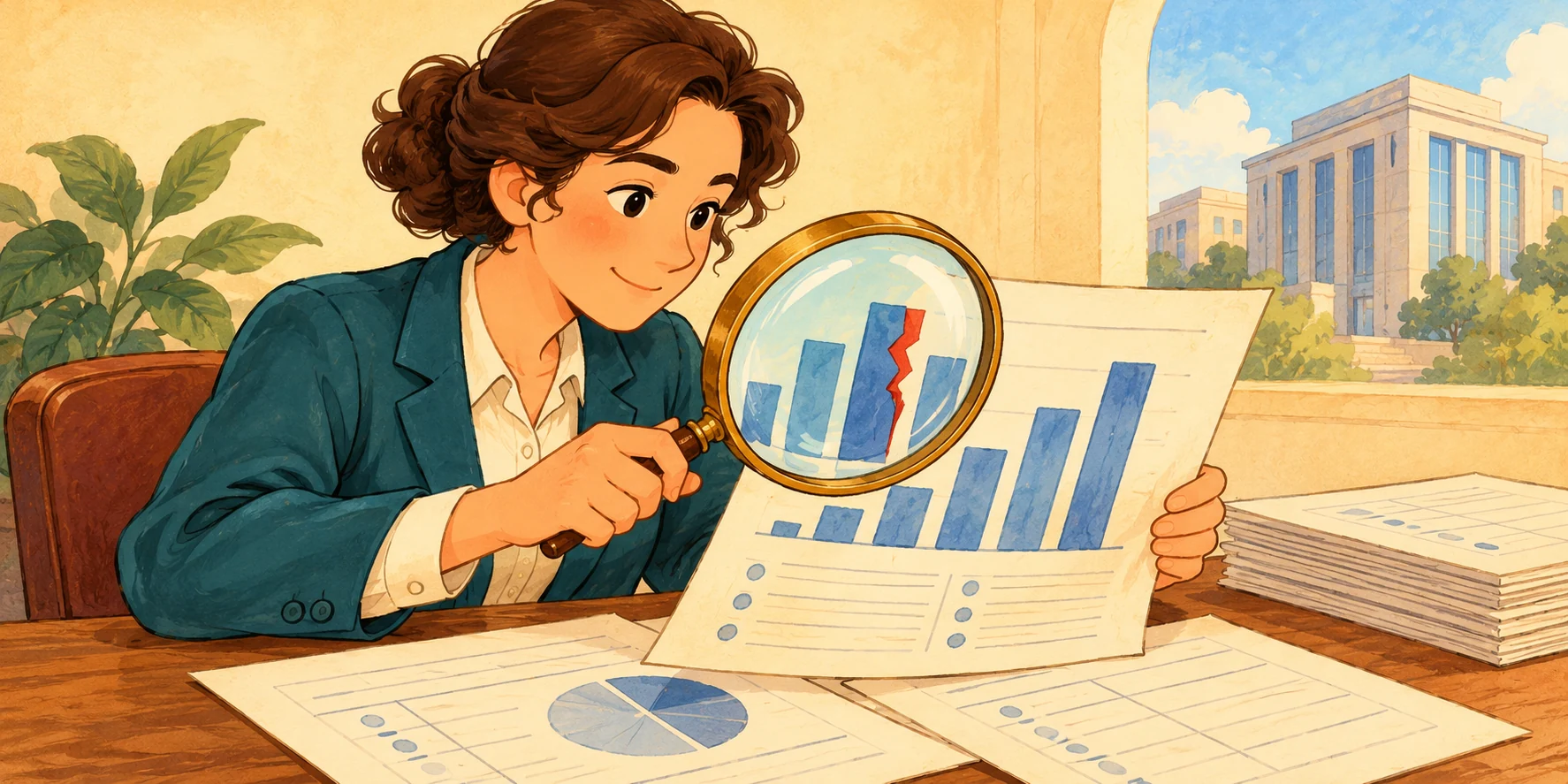
An audit checks whether financial information can be trusted. But hidden information, conflicts of interest and complicated financial products can make problems difficult to spot.
The Enron scandal, which came to light in 2001, and the financial crisis of 2008 remind us that keeping records is not enough. We also need to read them carefully, ask questions and check them independently.
Chapter 6 · Your Future
Financial Statements: A Health Check for a Company
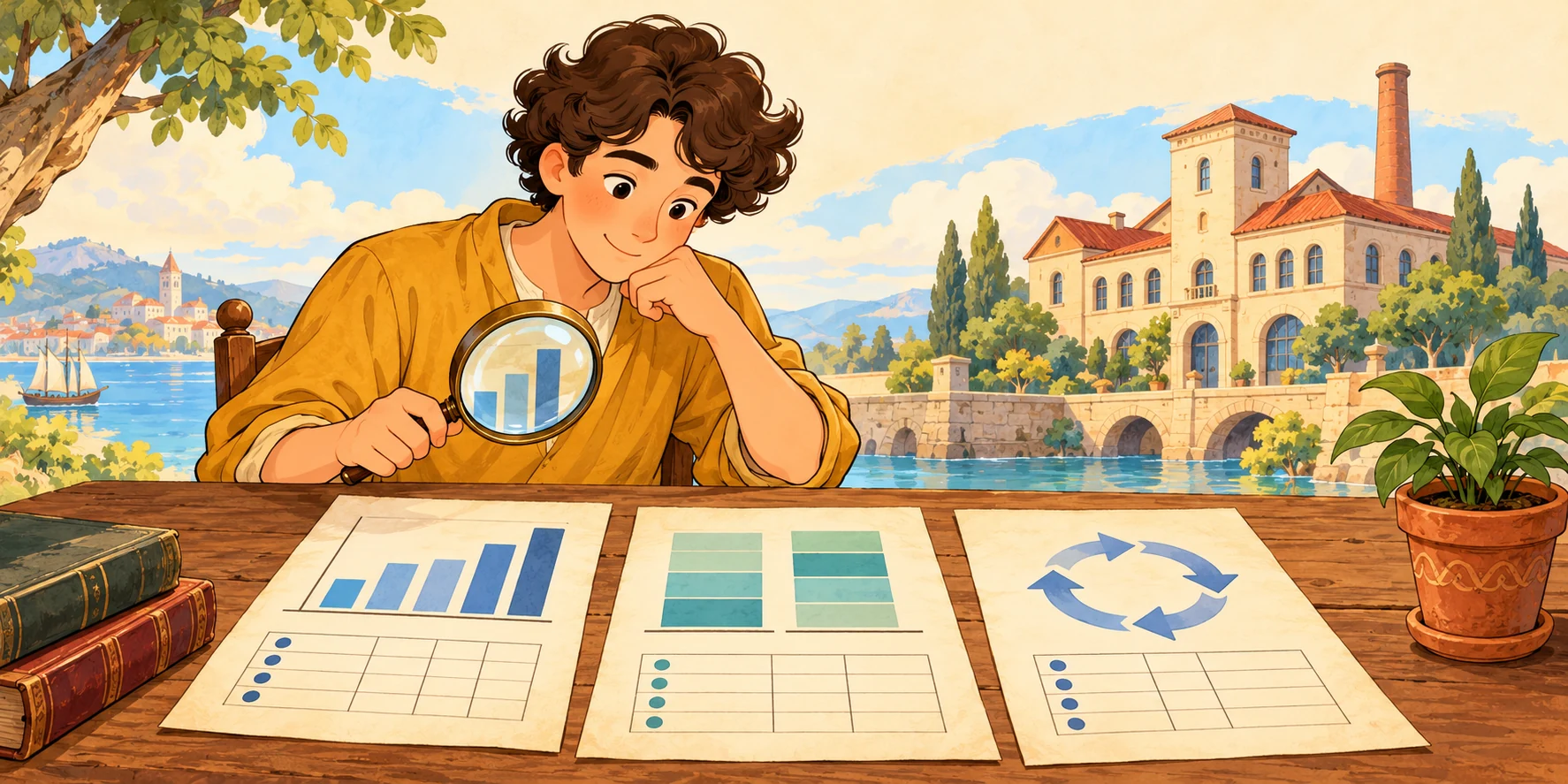
Businesses keep records of money coming in and going out. Many use double-entry bookkeeping to track assets, debts, sales and expenses. Some small businesses may use simpler methods.
Publicly listed companies in Japan must disclose financial information. Documents such as earnings reports and annual securities reports help us learn about their financial condition.
Three Useful Financial Statements
1. Income Statement (P/L): How much revenue, expense and profit did the company have?
2. Balance Sheet (B/S): What assets and liabilities does it have, and how are they financed?
3. Cash Flow Statement (C/F): Where did cash come from, and where did it go?
When Might You Use Them?
Choosing an employer: Learn about a company's sales, profits and debts. These provide clues about financial stability.
Checking a business partner: Consider whether a customer or supplier seems financially sound. Private companies may not disclose full statements.
Buying or selling individual stocks: Examine profits, debt and cash generation. Even strong financial results do not guarantee a rising stock price.
Bookkeeping is not just about memorizing numbers. It helps you investigate companies and make informed decisions.
Financial statements do not tell the whole story. Workplace culture, contracts, stock prices, future prospects and risks also matter.
Further reading: Japan Exchange Group: earnings disclosures, Timely disclosure information.
Use Bookkeeping Ideas at Home
A simple budget tells you how much you spent. Looking at both assets and debts tells you more about your financial position.
| Event | Cash-only view | Double-entry perspective |
|---|---|---|
| Move ¥100,000 between bank and brokerage accounts | Money went out | One asset decreases and another increases |
| Pay with a credit card | Cash leaves later | Record an expense and an amount owed, then settle the debt |
| Repay a loan | All payment looks like spending | Principal reduces debt; interest is an expense |
| Buy an investment fund | Cash decreases | Cash changes into an investment asset, whose value can fluctuate |
Try checking your net worth = total assets − total liabilities each month.
Try It Together!
1. Where Did It Come From? Where Did It Go?
Divide a notebook into two sides. Record receiving a gift or buying something. Remember that debits do not always mean increases, and credits do not always mean decreases.
2. Make a Treasure Map
List your cash, belongings and money you owe. Remember that an object's resale value may differ from its purchase price.
3. Play at Being a Merchant
Practice capital, inventory, sales and profit in our games. Watch how both sides of a journal entry change.
Book and Video That Inspired This Page
Historical notes on Chapter 4
The phrase “highly confidential” is a narrative description of information not generally available to the public, not evidence of a formal secrecy classification.
Necker's 1781 report was also intended to strengthen public credit and defend his administration. It did not provide a complete account of wartime finances. The 1785 necklace scandal involved fraud; Marie Antoinette did not buy the necklace. The French Revolution had many causes, including fiscal crisis, unequal privileges and political conflict.
Sources: Necker's 1781 report (original text); Palace of Versailles: The Diamond Necklace Affair.
Jacob Soll, The Reckoning: Financial Accountability and the Rise and Fall of Nations. A history of accounting, power and the rise and fall of institutions.
YouTube: A Japanese summary of The Reckoning and the Medici family
This child-friendly article is based on the summary provided by the reader, not a verbatim reproduction of the video or book. It adds qualifications where historical causes are more complicated.